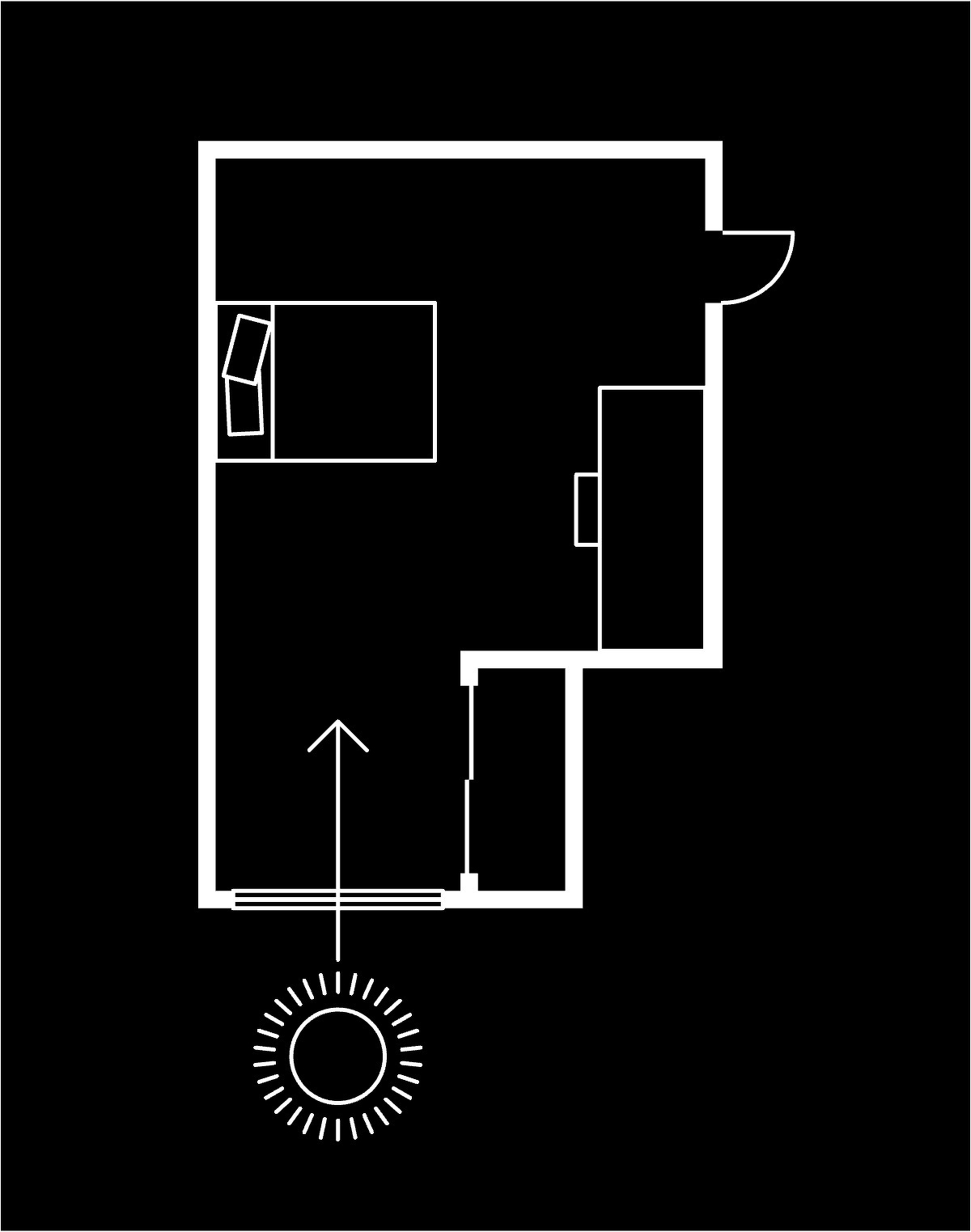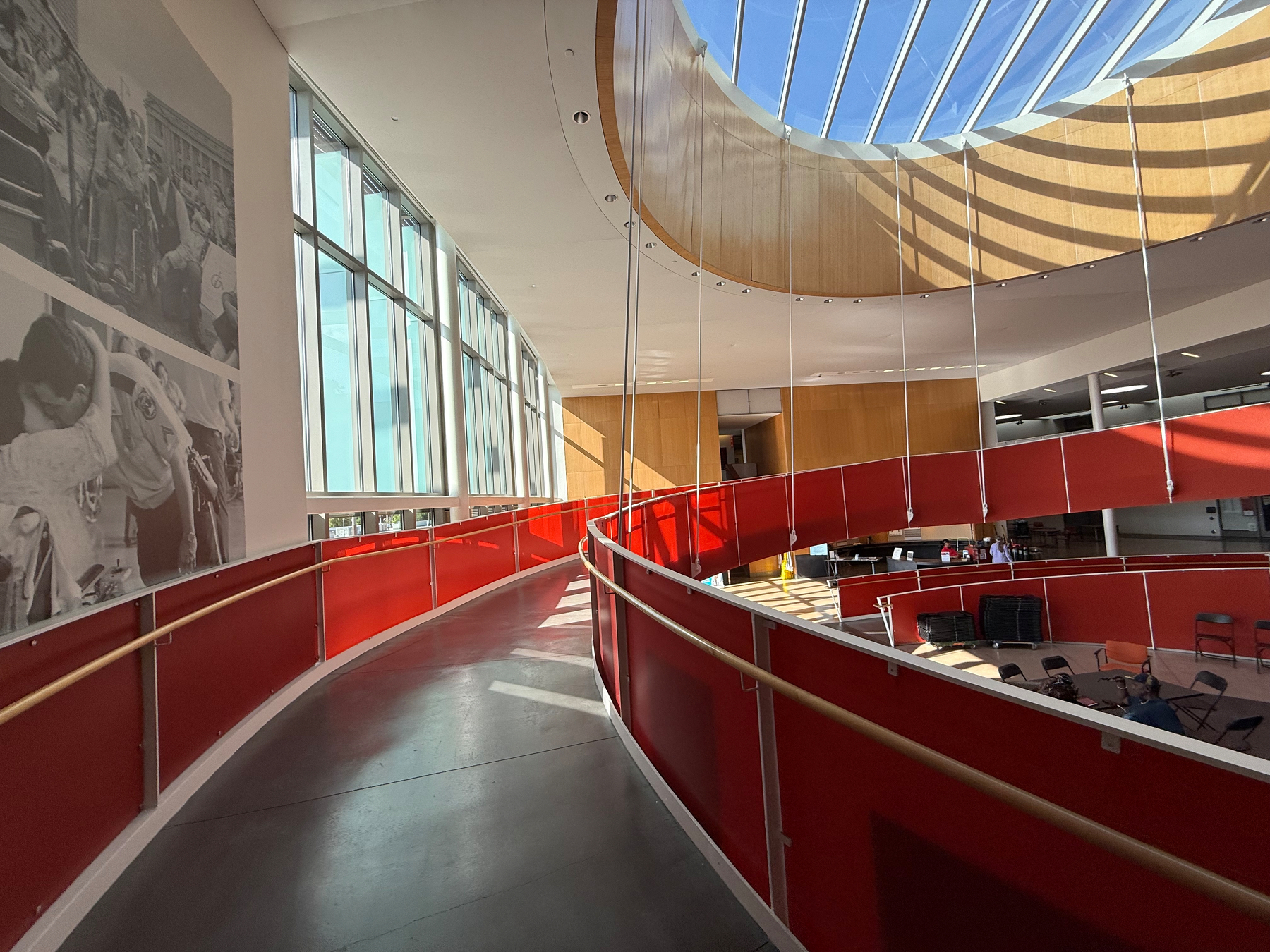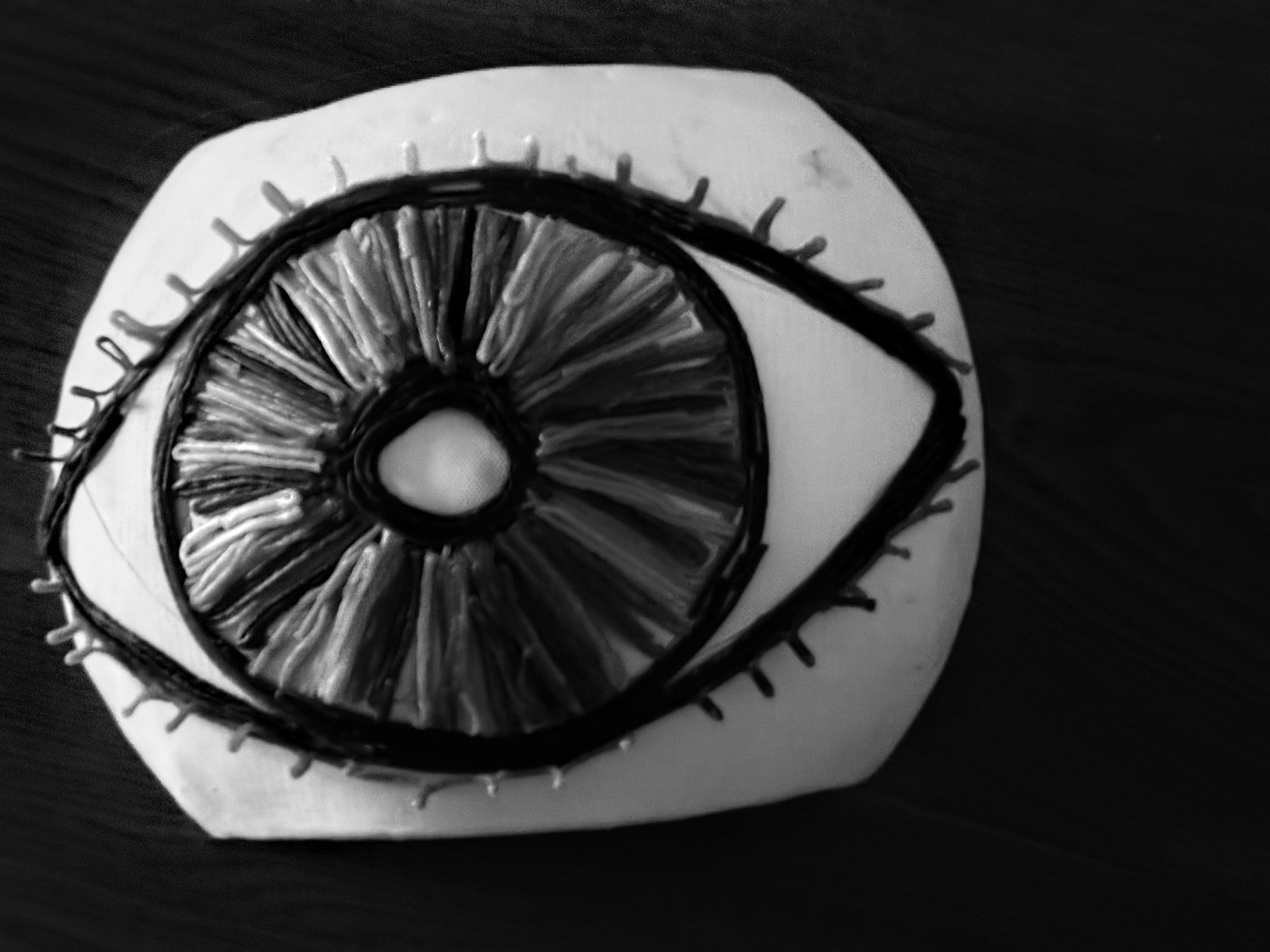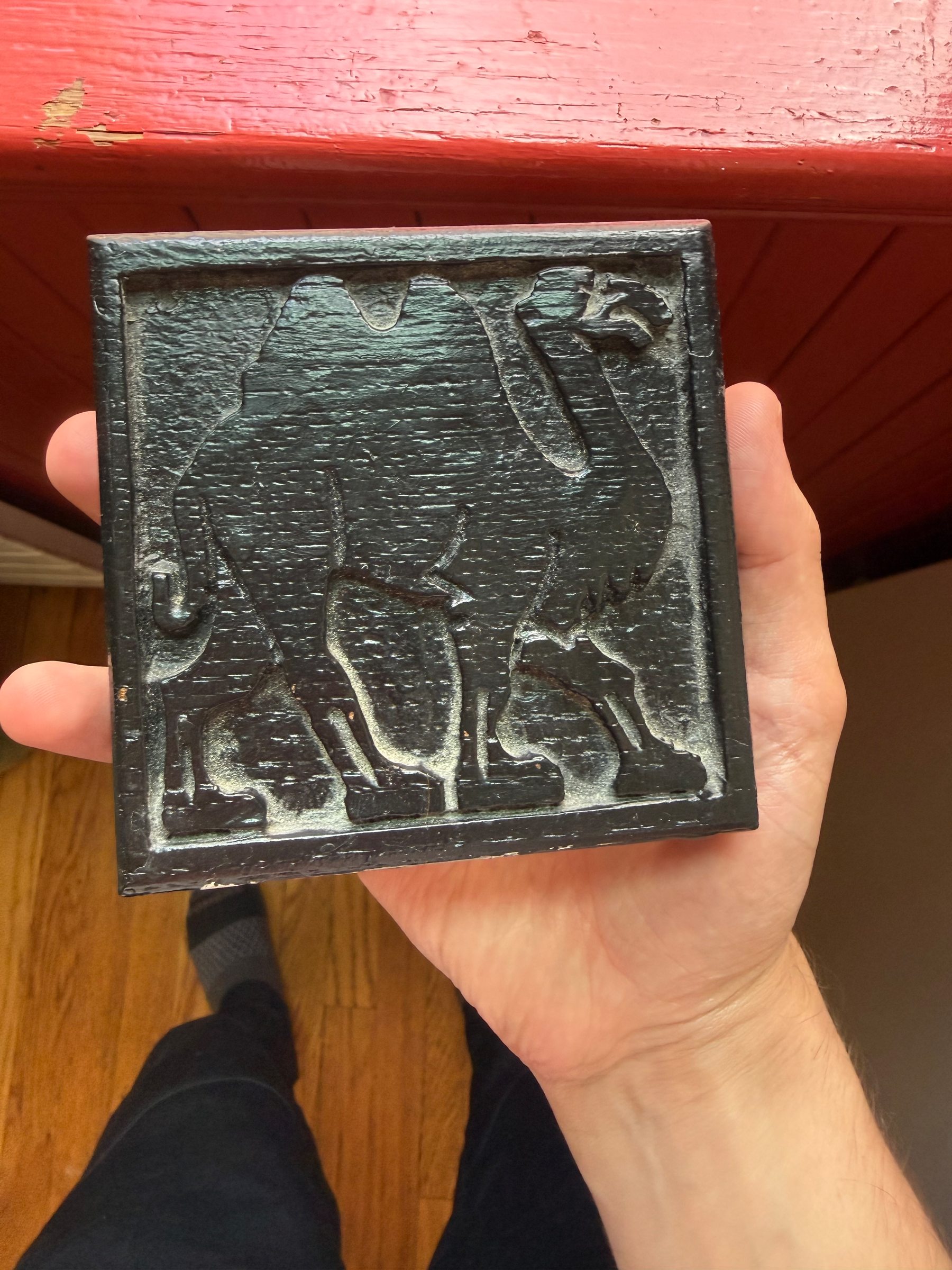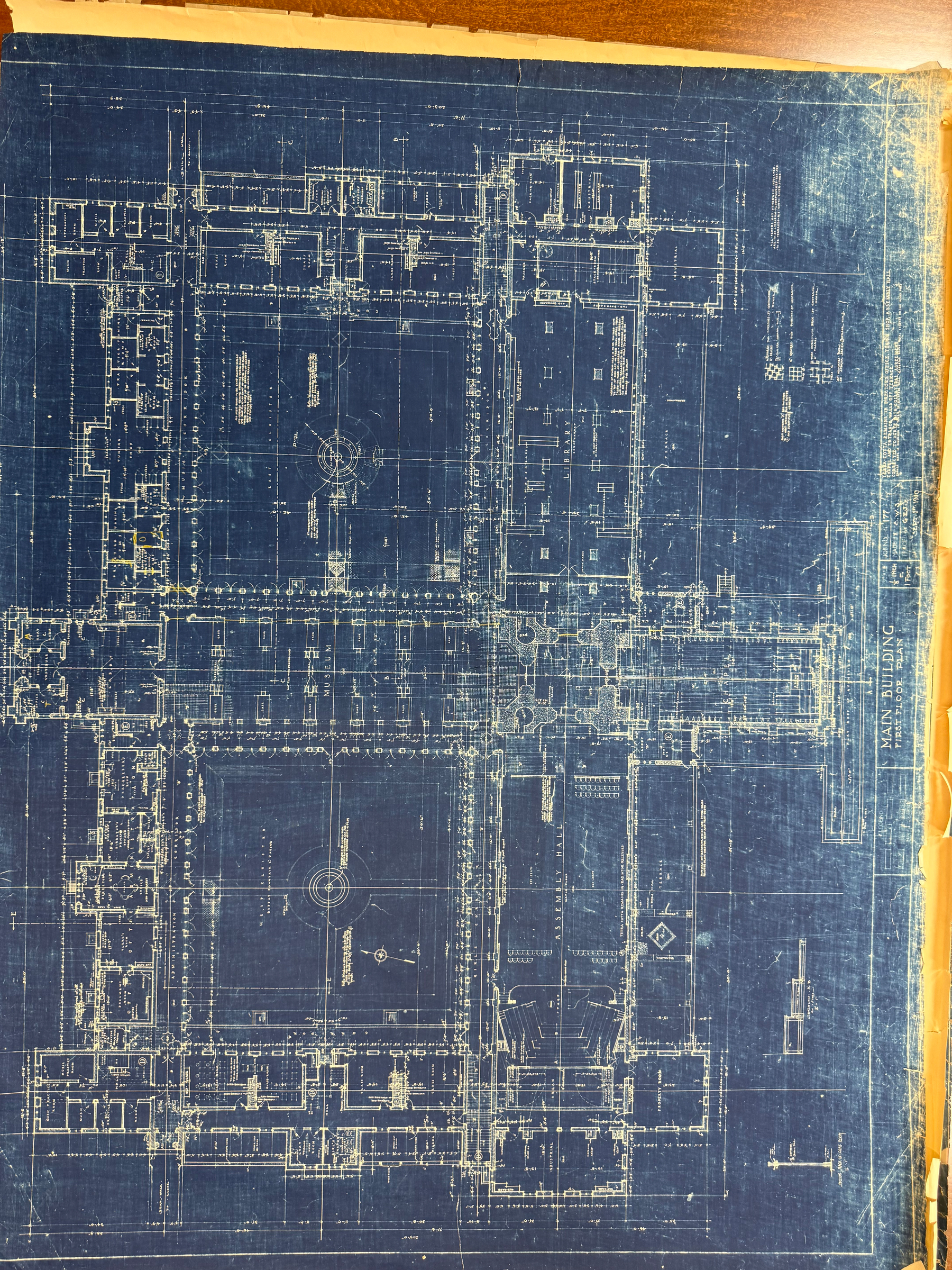
Clay frottage taken at the skate park


Had a nice trip to New York visiting friends and a few fun disability-related hangouts, a long breakfast with Alice Sheppard nerding out about disability arts, a visit to Adaptive Design Association looking at their makerspace, and a lovely meeting with Joel Sanders and Seb Choe of JSA/MIXDesign.


Nice way to do a flexible task lamp with no finger pinching


Caroline, Hannah, and I feeling the cardboard map


Conversation post BDW exercise at Perkins dormitories

Transcript


Cardboard map, with bump dots mapping the exterior HVAC sounds at the Perkins dormitories by the lower school.

Cardboard map of the dormitories at Perkins. It's an square buildings with lots of protusions around the edges and a large courtyard. Bump dots are placed around the edges of the buidling.

Haven’t complained in a while! Just haven’t had the energy, unfortunately. But here is a quick (and somewhat lazy) one sent to York’s accessibility office about their course registration website. I really wish light-sensitivity was better covered in WCAG, but that’s a complaint for another time…


Sound Window ideation

A high contrast sketch of lots of different sound window ideas. There are scooping ones, half-domed ones, tall ones, short ones, thoughts on materials, allll kinds of ideas related to creating sound windows, and if you want a fuller description of all of them see my previous link to google docs for a text-based description!

Photo of Karina and I measuring a wall at Walden Pond for a nonvisual design exercise on drawing a building’s footprint


From Viriginia Woolf: A Room of One’s Own:

“So I went back to my inn, and as I walked through the dark streets I pondered this and that, as one does at the end of the day’s work. I pondered why it was that Mrs Seton had no money to leave us; and what effect poverty has on the mind; and what effect wealth has on the mind; and I thought of the queer old gentlemen I had seen that morning with tufts of fur upon their shoulders; and I remembered how if one whistled one of them ran; and I thought of the organ booming in the chapel and of the shut doors of the library; and I thought how unpleasant it is to be locked out; and I thought how it is worse perhaps to be locked in; and, thinking of the safety and prosperity of the one sex and of the poverty and insecurity of the other and of the effect of tradition and of the lack of tradition upon the mind of a writer, I thought at last that it was time to roll up the crumpled skin of the day, with its arguments and its impressions and its anger and its laughter, and cast it into the hedge. A thousand stars were flashing across the blue wastes of the sky. One seemed alone with an inscrutable society.”


Months after listening I am still thinking about this interview with Kenneth Frampton. I’ve never heard him mention disability, but I think like it contains all the pieces needed to move from an architecture that merely comes from blindness to a politicized blind architecture.


This week’s notes on the conceptual framwork for the house


Charlotte’s two drawings for a house at Perkins. Still some guts and service missing and some changes coming but we are very feeling a lot of excitement and momentum, which is great. So appreciate her as a collaborator :-)

A floor plan of the house at Perkins. It has a straight interior hallway that leads past a guest bedroom, studio, kitchen, living space, and bathroom. Throughout the house are different types of windows that filter light and sound. A diagram overlaid on the plan showing the sound of the dam and the sun.


Two exterior wall sections for a house near Perkins

Two wall sections. Not sure how to describe them, maybe this descriptoin of the overall house will help: To design the house, we created the following “kit-of-parts.” It may be useful to think of the house in two categories of elements: First, the normal enclosure, which keep a New England house warm, dry, airtight, and durable. And second are what can broadly be called “sensory aperture elements” or things that selectively let in sound, filtered light, vibration, weather information, and external presence. These apertures effectively produce a “listening house” which can be tuned by the inhabitant.

Quick diagram of metric (top) vs. imperial (bottom) standard architectural scales. Was interested in understanding how these scales are determined in order to develop an architectural scale set for tactile plans, which in my experience need to be much bigger to be legible with the same level of detail.

Two white rendered chairs are being scaled down in metric and imperial units, showing the different stopping points these "standard" scales use.

Old drawing from 2016, and some notes on it

This is an old drawing I did called "Bird Town" which is basicallly a chaotic town with a lot of birds. For your sanity and mine I'm not going to describe all of it. It's a very complex image. But suffice to say, it is a very compplicated image with a lot of birds doing a lot of different things. Detail from the image which depicts a bird and a balloon and lots of lines that are hard to understand. They read kind of like marks on a page more than drawings of anything in particular when you are this zoomed inThis is another detail shot and shows some of the birds on the ground


And then also connecting to artists like SOPHIE, (if you’re not familiar, a trans artist who used a synthetic hyper edited voice with great expressive range.) Link1, Link2, Link3


I’m still so obsessed with the synthetic speech and gregorian chant in Toshi Ishiyanagi’s Music for Living Space, and its implications for the artful use of screen readers and synthetic speech.


A list of a few things that I’ve been interested in recently.

  • Met Marco Salsiccia and found his BlindSVG generator and lots of other cool materials on his website
  • Andrew Stone showed me KnowHow Shop’s ceramics studio for the blind ceramicist Don Katz, which used 1:1 prototypes of construction details as the primary design method
  • In that vein, I enjoyed Abraham Cruz Villegas Art21 short on Autoconstrucción, a direct construction practice based on self-built architecture in Mexico City
  • One of my favorite artists, Lenka Clayton, was in the recent Human Nature episode of Art21
  • Have been designing wall sections for the hosue at Perkins, and thus revisiting Andrea Deplazes
  • Some of the work of Rael San Fratello has some tactile interest
  • Have loved picking through the reading list on Life, Nature, Time, Community & Happiness at the end of Samin Nosrat’s cookbook Good Things, and oppositely, have just started Misery Meals
  • A conversation with Lavendar Darcangelo has me revisiting plain language, and thinking about the tension in Crip Authorship between Mel Y. Chen’s “to hell with accessible writing” piece and Kelsey Acton’s plain language manifesto
  • Blood in the Machine by Brian Merchant has been interesting
  • Have almost finished Paul Fry’s open course on Literary Theory. It’s almost fifteen years old, but the final four lectures have been immensely helpful in grounding some ambivalence I’ve been feeling around disability as identity

Have also divested from a few things:

  • Have replaced google search with Kagi (weird politics, horrible accessibility backslide, and nonconsensual AI is getting to be too much.) You’re next GMail!
  • Also shifting out of Adobe into free and open source programs like GIMP, Krita, and Typest.
  • Still love Rhino, and vibe-coding actually lets me bypass huge parts of the visual interface, have been talking with their developer team about making it more blind-friendly. May be pretty close to a totally nonvisual 3D modeling workflow there.
  • I’m waiting for the Microsoft divestments to feel possible. Maybe I should just jump ship and start using EMacSpeak? The surveillance technology in Gaza is sickening.
  • Have not boycotted OpenAI, like everyone else in academia seems to be doing these days, but there’s definitely a lot of ambivalence there. More in this in the future.

Origami sailboat from a blindfolded origami workshop. My table neighbor said the backside of the paper felt shiny. To me it also felt waxy, like there was sealant on the boat, vs the rough papery sails.

Four fingers touching a paper origami sailboat made with origami paper that has a red glossy coating on one side and nothing on the other, creating very different textures between the front and back.